
Still Here Without the Faith
What it means to keep working when the mission no longer carries you

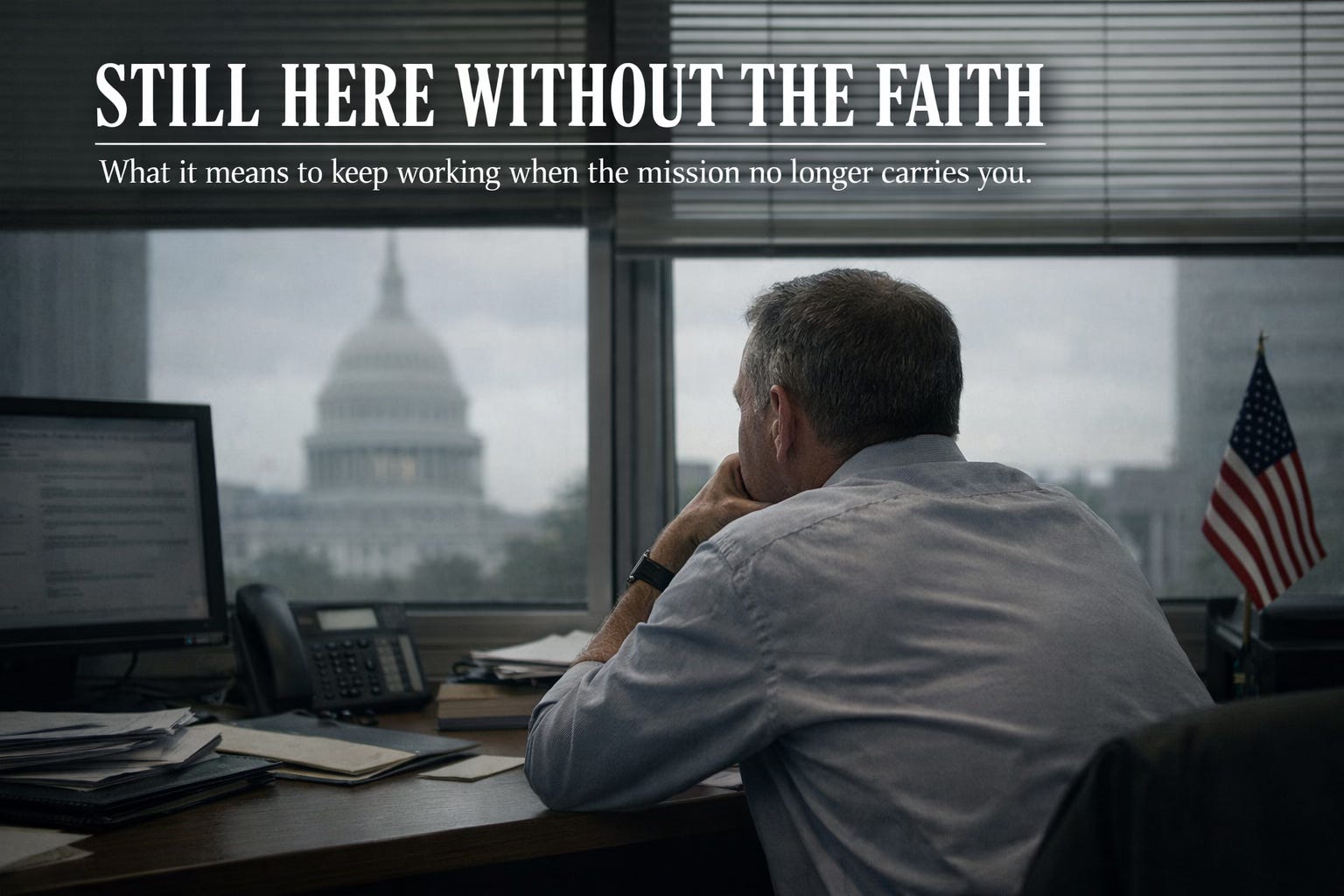
In the hushed corridors of public service, there comes a moment, barely perceptible, rarely named, when the work begins to lose its anchoring in belief. No earthshaking event announces it; no single memo or policy shift triggers it. Still, the calendar fills with meetings, reports are filed on time, and performance reviews land with an approving nod. Yet the vital current of purpose that once pulsed through each task has thinned to a faint echo, leaving behind a routine cadence that feels procedural rather than profound.
For federal employees, disentangling from that drift is tangled by the very structure of their lives. Health benefits cling like a lifeline, family stability is woven around predictable paychecks, and community expectations press in. To walk away threatens more than a career, it risks the delicate architecture of others’ dependence. In that light, remaining is not an act of wholehearted agreement but a pledge of continuity, a quiet insistence that someone must keep the wheels turning.
Public service often arrives like a clarion call: ringing with promises of mission and the chance to shape society. In the early years, that language of service fuels long nights and steep trade-offs. But as days turn into seasons, experience carves into perspective. Constraints tighten like a vise, priorities pivot without warning, and the gap between noble intent and messy outcomes widens. Belief does not always shatter in a single blow; more often it recedes like dusk, transforming into something muted, measured, and contained.
What steps into that vacancy is competence. People lean into precision—untangling bureaucratic knots, warding off systemic failures, shielding citizens from avoidable harm. This steady craftsmanship rarely feels stirring, and accolades seldom follow. Yet in moments of turbulence, this quiet mastery and ethical restraint stand as bulwarks as critical as grand visions ever were.
Still, there is loss in this evolution, even if it goes unacknowledged. Many who walked in expecting a seamless alignment of effort and values find themselves grieving an unmet promise. The sting feels personal, as if they alone misstepped, rather than recognizing it as the fault of a structure ill-suited to sustain unbroken conviction. It is reasonable, and necessary, to mourn that lost alignment.
All around, the pressure to resolve this inner tension builds. Stay and recommit, or break free and reclaim integrity? Life seldom offers such neat crossroads. What most people need instead is the grace of time: space to sit with uncertainty without forcing a decision, moments to gather strength, and quiet hours to sketch a future that need not spring to life immediately.
A job can shed its capacity to inspire without stripping you of your values or your worth. The real peril lies not in overstaying your tenure but in believing that your identity is synonymous with that role. When belief ebbs, it leaves behind a silent void. If ignored, that emptiness can swell until the job consumes more of your world— not because it fuels you, but because it displaces everything else.
Refilling that void does not demand a radical reinvention. It often begins in small gestures: the comfort of a morning routine, the simple satisfaction of helping a coworker navigate a thorny issue, or the tangible warmth of caring for loved ones. It grows in acts unbound by lofty jargon, planting a garden patch, volunteering at a local shelter, or simply pausing to breathe deeply after weeks of unacknowledged stress.
Many rediscover steadiness by narrowing their gaze. They attend to what feels grounding today, rather than chasing the echoes of past inspiration. They find purpose in reliability, being the colleague who listens, the manager who notices, or the friend who shows up. Some seek relief in local service, where faces are familiar and the impact immediate. Others turn to learning, curiosity, or the quiet preparation of skills that may bloom only years hence. None of this needs to supplant the day job; it simply reminds you that meaning has many wells to draw from.
Belief may return in a transformed guise, or it may not. Either way, life need not remain hollow while you wait. For those who stay as belief shifts, the work becomes one facet of a broader life again. This recalibration is not resignation, it is an act of care, a means of preserving oneself so that future decisions arise from thought rather than desperation. Staying, filling the space honestly, and tending to what still feels real is not giving up. It is how you keep yourself intact.