
75 Days: The Checkpoint
One quarter of the runway is gone. Here is where Washington actually stands, where you should stand, and how to close the gap before October 1.

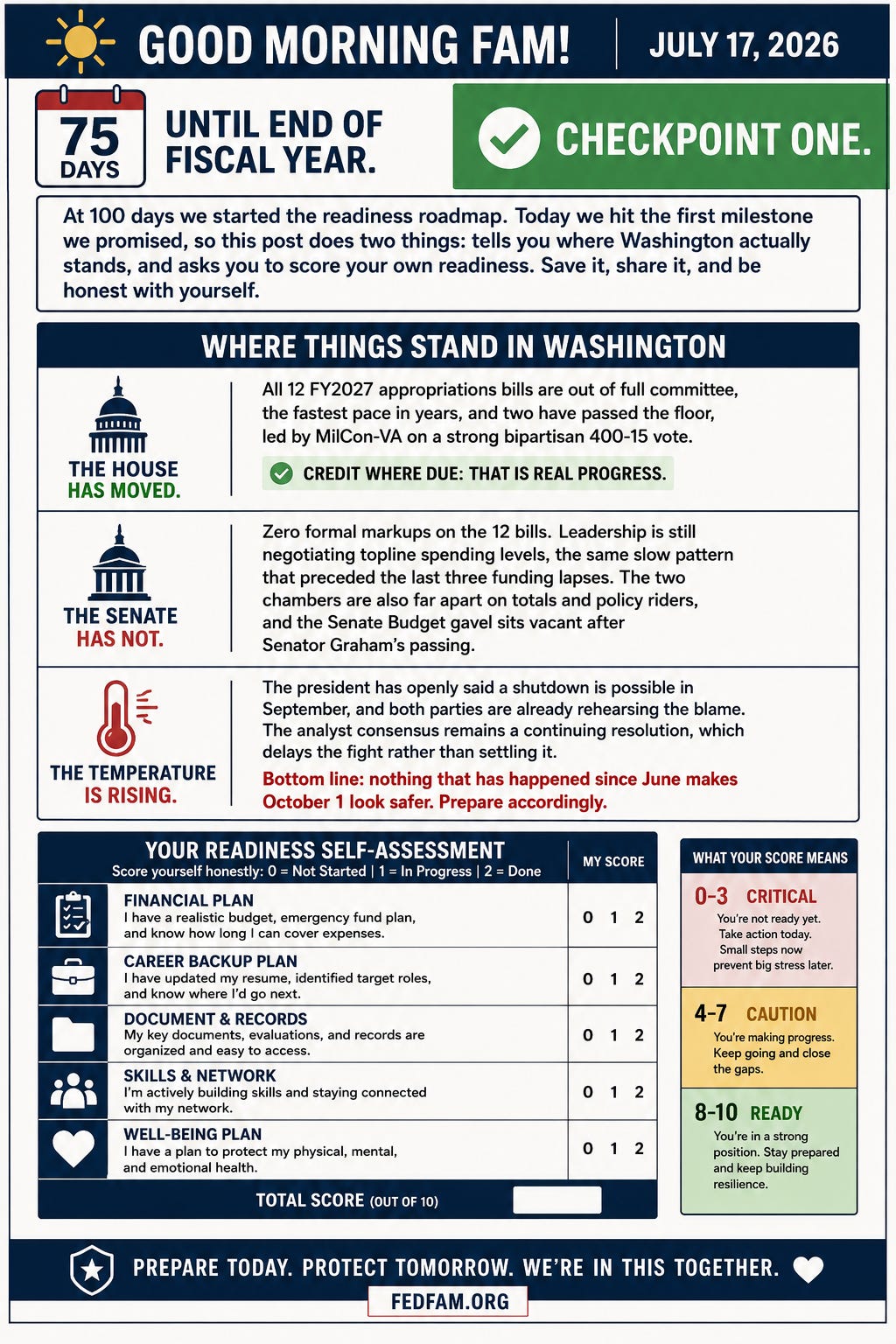
On June 22, we marked 100 days until the start of Fiscal Year 2027 and launched a readiness roadmap built on a simple premise: you cannot control what Congress does by October 1, but you can control whether your household is ready for whatever they do.
Today is the first checkpoint. Seventy-five days out. A quarter of the runway is behind us, and this is the honest accounting, on their end and on yours.
Where Washington Stands: The Verified Scoreboard
Start with the genuine good news, because there is some. The House Appropriations Committee has moved all twelve FY2027 spending bills through full committee, completing the last markup, Defense, before the July 4 recess. That is the fastest the committee has moved in years, and its chairman is not wrong to call it remarkable. Two bills have passed the full House, led by Military Construction-VA on a strong bipartisan 400-15 vote, with the State Department funding bill queued behind them.
Now the rest of it. The Senate has held zero formal markups on the twelve bills. Leadership is still negotiating the topline spending levels that have to come before any bill can move, the same slow-start pattern that preceded the last three funding lapses. The two chambers are far apart on the numbers themselves: the House bills total roughly $1.856 trillion, about 13% above this year, with the increases concentrated in defense and homeland security, and they carry policy riders that analysts widely expect will not survive the Senate. Every one of those gaps has to be negotiated, bill by bill, in the weeks that remain after the chambers return from their August recess.
Three wildcards make the calendar harder, not easier. The Pentagon’s budget assumes roughly $350 billion will arrive through a third reconciliation package that senior Senate appropriators have flatly said is not happening. An $87.6 billion supplemental request tied to the Iran conflict is now competing for the same floor time. And the Senate Budget Committee gavel sits vacant after the passing of Senator Lindsey Graham, at precisely the moment budget mechanics matter most.
Then there is the temperature. The president has said openly that a shutdown is possible in September unless the Senate changes its rules. Members of both parties are already rehearsing the blame for a lapse that has not happened. When the people who control the calendar start narrating the shutdown in advance, believe the calendar, not the reassurances.
The analyst consensus remains what it was at 100 days: a continuing resolution is the most likely outcome, finishing all twelve bills on time is unlikely, and a CR does not end the risk, it reschedules it. Nothing in the last 25 days has made October 1 look safer. Plan accordingly.
Where You Should Stand: The Self-Audit
At 100 days, the message was start. At 75, the message is measure. Seven questions, one point each, and the only person you are grading for is yourself.
One. Is your emergency fund transfer actually running? Not planned, not intended, running, automatically, every payday. Roughly two and a half months of paychecks remain before October 1. Automatic beats willpower every single time.
Two. Is your survival number written down? The bare-bones monthly minimum: housing, utilities, food, insurance, transportation, minimum debt payments. That number is what turns a scary unknown into a math problem, and it tells you exactly how many weeks your cushion buys.
Three. Is your paperwork folder built? Recent earnings statements, your SF-50, pay records downloaded where you can reach them offline, direct deposit and contact information verified current. Systems get slow and access gets hard at exactly the moment you need these most.
Four. Do you know your lapse status? Excepted, exempt, or furloughed. This year’s designation, not last year’s, because reorganizations have moved people. Your agency’s contingency plan spells it out, and your supervisor or HR can confirm it. Remember: back pay is guaranteed by law for both excepted and furloughed employees. Knowing which you are shapes everything else you plan.
Five. Have you called your lenders? Mortgage servicer, landlord, auto lender, card companies, utilities. Ask now, while you are calm and current, what hardship programs exist for federal workers, whether using them touches your credit, and what paperwork they will want. A proactive borrower gets flexibility a silent one does not. And after the last shutdown left some employees with credit scores down 200 points despite back pay, this call is not optional busywork. It is armor.
Six. Do you know your TSP loan rules? Contributions pause with your paycheck and resume with it. But if you carry a TSP loan, missed payments have their own rules, and you want to know them in July, not discover them in October.
Seven. Have you had the household conversation? The budget, what pauses, who calls whom, how you hold each other up if a paycheck is late. Money stress is heavier when it arrives as a surprise. Kids feel tension; a calm plan protects the whole house. And your Employee Assistance Program is free, confidential, and there before crisis, not just during it.
Scoring, honestly. Seven out of seven: you are ready, and we are proud of you. Four to six: solid, close the gaps this month while there is still cushion-building time. Three or under: no shame whatsoever, this roadmap exists precisely so nobody starts from zero in late September. Start with the automatic transfer this weekend. It carries the rest.
Why We Do It This Way
This community walked through three funding lapses in the past year, including 76 days that rewrote what federal families thought they could endure. We learned some things the hard way. Back pay makes you whole on paper and leaves the late fees, the interest, and the credit damage behind. Food bank lines in Laredo filled with people who had never needed one. The employees who fared best were not the highest paid. They were the prepared.
Preparation is not pessimism. It is the opposite: it is what lets you watch the September brinksmanship without your stomach dropping, because your house is already in order. If Congress passes every bill on time and proves the whole roadmap unnecessary, that is the best possible outcome, and you will have an emergency fund and an organized file cabinet to show for it. There is no version of this where readiness was wasted.
The Road From Here
The plan we committed to stands. At 50 days, the next full checkpoint and roadmap review, timed for just after Congress returns from August recess, when the real September dynamics will be visible. From 25 days out, a daily countdown, one day and one step at a time, all the way to October 1. In between, we track every development that moves the odds, so you do not have to refresh the appropriations calendar yourself.
Seventy-five days. Score yourself today, close one gap this week, and check on a colleague who might be starting late.
You cannot control Congress. You can control your house. And you are not doing any of it alone.